






Copernicus Festival 2026 attracted 5,000 participants to Kraków and over 10,000 online viewers, once again confirming its status as one of the leading popular science events in Poland. The Polish National Contact Point at the National Centre for Research and Development (NCP at NCBR) not only provided organizational support for the event but also contributed to its substantive programme, including sessions dedicated to European Research Council (ERC) grants held on 19–20 May 2026.
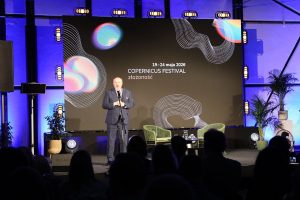
The special character of the festival was further highlighted by the involvement of the European Research Council and the National Centre for Research and Development (NCBR), both partners of the event. The official opening featured Prof. Jerzy Małachowski, Director of the National Centre for Research and Development (NCBR). – I encourage you to approach this festival with openness and curiosity, with readiness to absorb knowledge, ideas, and inspiring thoughts shared by leading Polish researchers. It is a unique opportunity to listen to the voice of science, which helps us better understand the world and humanity’s place in a changing reality, – said the NCBR Director during the evening opening gala.
ERC stars on their research
One of the key elements of the programme was the recurring ERC Talks series, held daily on the main stage. As part of these sessions, recipients of prestigious ERC grants presented their research, explaining complex scientific issues in an accessible way. The speakers included leading Polish researchers such as Prof. Kinga Kamieniarz-Gdula, Prof. Stefan Dziembowski, Prof. Andrzej Udalski, Prof. Piotr Sankowski and Prof. Justyna Olko.
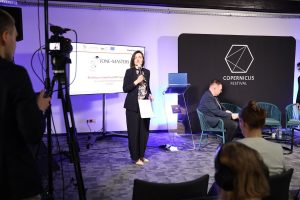
The programme of the main stage was enriched by talks delivered by three ERC grantees from abroad: Prof. Hiranya Peiris, Prof. Anil Seth and Prof. Ewa Paluch, highlighting the international dimension of the festival. An important role was also played by ERC Ambassadors, Prof. Justyna Olko and Prof. Michał Tomza, as well as by a member of the ERC Scientific Council, Prof. Leszek Kaczmarek. This year’s festival featured an expanded programme with a second stage hosting dedicated side sessions, including expert-level ERC sessions.
What do groundbreaking research projects really mean?
The first day was dedicated to the theme of groundbreaking nature, exploring what defines the breakthrough character of research in the context of the ERC. Katarzyna Kubica-Oroń, an expert from the Polish National Contact Point at the National Centre for Research and Development (NCP at NCBR) and co-organiser of the festival, introduced participants to the concept of groundbreaking research and the principles underlying one of the world’s most prestigious research funding schemes.
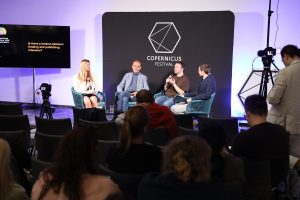
In the panel discussion titled “What do groundbreaking research projects really mean?”, chaired by Prof. Róża Szweda and Dr Krzysztof Szade, the speakers emphasized that “groundbreaking” is not a single, clear-cut category. The discussion was opened by Prof. Leszek Kaczmarek, who explained that the evaluation of grant proposals does not rely on the opinion of a single reviewer, but is the outcome of a collective discussion among all evaluators. Dr Stylianos Lefkopoulos, editor at the scientific journal Nature, introduced the concept of editorial thinking, noticing that novelty, importance or usefulness do not automatically imply groundbreaking research. In his view, truly groundbreaking studies are those that introduce ideas that change the way we think about a given problem.
Prof. Kaczmarek added that he begins assessing grant proposals by looking at the research methods, and sees breakthrough potential in the combination of methodological robustness and an element of genuine scientific surprise. He also highlighted the uniqueness of ERC grants as a bottom‑up funding programme, in contrast to many national systems, including those in Poland. Concluding the discussion, he remarked that there is no greater excitement than conducting truly groundbreaking research.
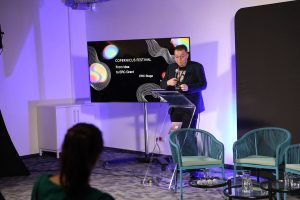
How to build an ERC project? Practical insights from grantees
During the panel session, ERC grant holders addressed the question “How to build an ERC project around a strong scientific question?”. Prof. Michał Tomza, ERC Starting, emphasized that a key competence for applicants is the ability to convince the scientific community of their idea and to summarise the project in a single sentence answering three fundamental questions: “What?”, “Why?” and “How?”. “The more credible you are, the more ambitious – and even bold – your project can be,” he said.
Dr Ewa Chrostek, ERC Starting Grant holder, noted that it is important to surround oneself with people who have strong and inspiring ideas, as this fosters the development of one’s own concepts. She also defined a strong ERC candidate as an independent, competent and internationally recognised researcher capable of using clear, jargon-free language. Dr Paweł Nowakowski highlighted the importance of choosing the right research topic, understanding the needs of one’s scientific community, and the ability to work across disciplines.
In the second part of the ERC session, the discussion on the concept of groundbreaking research continued. In the panel titled “How is breakthrough potential assessed?”, moderated by Prof. Michał Tomza and featuring Prof. Alicja Józkowicz, Prof. Bronisław Rudak, Prof. Agata Nalborczyk and Prof. Joanna Odrowąż-Sypniewska, speakers stressed that the ability to go beyond the current state of knowledge and to manage research risk consciously is essential. They pointed out that breakthroughs may arise from a new research question, a new methodology, or a combination of both. The discussion also highlighted differences between the ERC approach and the more conservative strategies often seen in national funding systems.
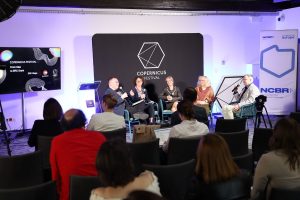
The day concluded with a presentation by Renata Kaszewska-Mika, Project Coordinator at the National Programmes and EU Funds Department of the NCBR, who introduced the NCBR LIDER UP programme. As she emphasised, it offers an opportunity to develop the competences of early-career researchers. She also explained what NCBR offers to researchers and how to apply for the programme.
Different paths to ERC – inspirations from the second day
The second day, titled Career Paths, was dedicated to exploring different routes leading to ERC grants. Opening the session, Katarzyna Kubica-Oroń, NCP at NCBR highlighted the diversity of the scientific community present at the Copernicus Festival, as well as on the ERC Stage.
In the session “ERC Testimonials: different paths to ERC”, Prof. Artur Obłuski emphasised the inclusiveness of the scientific world, pointing out that even an unconventional career path can lead to outstanding achievements. Dr hab. Anna Siekierka underlined the importance of going beyond the laboratory and engaging with society, allowing research to have a real impact on our lives. Presentations by Dr Łukasz Bola and Dr Krzysztof Szade clearly showed that the road to ERC is a long-term process requiring persistence, mobility and openness to criticism. Building a strong track record and competences well before submitting a proposal is essential – it is “a marathon, not a sprint.”
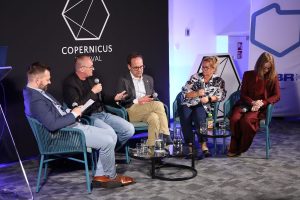
In the final panel discussion titled “CV and track record in ERC evaluation”, moderated by Prof. Paweł Dydio, participants included members of ERC evaluation panels: Prof. Stefan Dziembowski, Prof. Małgorzata Filip, Prof. Robert Hołyst and Prof. Ewa Gruszczyńska.
During the discussion, Prof. Stefan Dziembowski emphasized that candidate evaluation is not based on a simple “counting of publications”, but rather on the real impact on the development of a given field. Prof. Ewa Gruszczyńska pointed out that the key factor is the potential of the project and clear answers to the questions: “Why me?”, “Why now?”, “Why this discipline?” and “Why this project?”. As she noted, all these elements should be evident at first glance in the candidate’s CV.
Leaders in science
The third day of the festival featured the NCBR Session, including two panel discussions. The first focused on the LIDER programme and brought together young leaders of Polish science. Participants emphasized how important their involvement in the programme had been for their scientific development and how it contributed to the growth of their research careers.
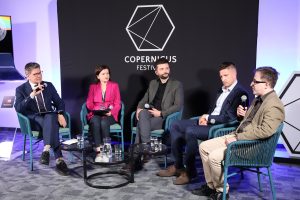
The second discussion addressed the growing phenomenon of student drop-out rates, which have been increasing in recent years. More and more young people decide to leave their studies prematurely or change their field of study multiple times. The panelists discussed what universities can do to better retain students and how public policy can support these efforts. Both panels were complemented by a short presentation on the concept of lifelong learning and the opportunities for supporting universities through European funds.
What’s next? New challenges and continued collaboration
The ERC session at Copernicus Festival 2026 demonstrated the importance of initiatives that combine science communication with practical support for the research community. Thanks to the involvement of the Polish National Contact Point at NCBR and the presence of NCBR, the event gained a systemic dimension, becoming a platform for dialogue on how to effectively advance Polish science in the European context. Success in ERC projects requires not only scientific excellence, but also courage, strong communication skills and institutional support. The synergy of these elements may translate into a stronger presence of Polish researchers in Europe’s most prestigious funding programmes.
KPK NCBR and NCBR plan to continue this collaboration in future editions of the festival, recognising it as a real opportunity to further strengthen the potential of Polish researchers. The next Copernicus Festival will bring new challenges, new opportunities and fresh inspiration for the research community.
