





More than 300 participants attended the “Horizon Europe for Business” conference, held on May 20, 2026, in Warsaw and aimed at companies, startups, and innovators. During the event, a new programme—AKCES NCBR—was launched. It combines business mentoring, grant support, and expert guidance from the National Contact Point for the EU Research Programmes at the National Centre for Research and Development (NCP at NCBR), dedicated to the EIC Accelerator under the Horizon Europe programme.
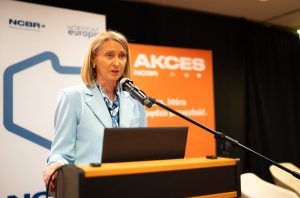
The conference host, Renata Rycerz, Deputy Director of the NCP at NCBR, emphasized that Poland has the potential to become a leader in many ventures and that the event marked an important step toward strengthening innovation and building a strong position for Polish startups in both European and global markets.
Arleta Malasińska, President of the Management Board of AKCES NCBR Ltd., highlighted during the programme’s launch that gaining access to the EIC Accelerator today requires more than just strong technology, as competition is intense. A startup must demonstrate the global potential of its project, the scalability of its business, investment readiness, and a clear commercialization strategy. She noted that a competency gap remains in this area, and the launch of HPN DeepTech with the EIC Launchpad track announced today will help address these challenges.
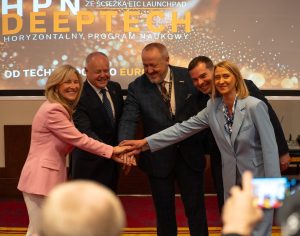
Professor Marek Gzik, Secretary of State at the Ministry of Science and Higher Education, stated that although Poland is developing dynamically, the level of innovativeness of its economy remains relatively low—an issue central to the conference. The Director of the NCBR, Professor Jerzy Małachowski, emphasized the institution’s goal of building bridges between science and business. Addressing entrepreneurs, he highlighted the development of the “Synergia” programme, which integrates various support instruments to provide a broader offer in areas such as space, medical, and military technologies, as well as tools like HPN DeepTech with the EIC Launchpad track, supporting companies in applying for the European Union startup grants.
Participation of Polish Companies in Horizon Europe
During the substantive part of the conference, Dr. Piotr Świerczyński, Director of NCP at NCBR, presented the current state of Polish participation in Horizon Europe. He noted that Polish entities have so far secured €927.9 million for the implementation of 1,727 projects, with the business sector accounting for nearly 22%.
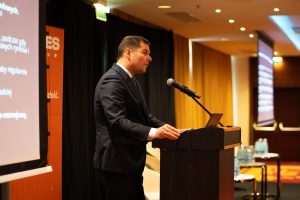
He emphasized that participation in Horizon Europe offers significant development opportunities, but also brings challenges. The high level of competition requires both experience and a strategic approach, while international projects demand considerable commitment. He also noted that many companies remain focused on achieving quick financial results, even though Horizon Europe provides much broader benefits, including access to knowledge, partnerships, and new markets for innovative products and services.
Further presentations included Zbysław Ziemacki from the Ministry of Development and Technology, who discussed the European Competitiveness Fund, and Dr. Jacek Sowa from Pratt & Whitney Rzeszów, who provided an industry perspective on the importance of Horizon Europe for the aviation sector.
Let’s talk about the internationalisation of Polish enterprises
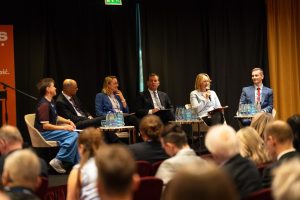
How can the participation of Polish companies in the Horizon Europe programme be strengthened? This question served as the starting point for a panel discussion moderated by Ola Ihnatowicz, Head of the Innovative Europe area, NCP at NCBR. The discussion brought together representatives of public administration, business, and support institutions, including Dr. Piotr Świerczyński (Director of NCPat NCBR), Dr. Małgorzata Ciechomska (Director for Strategy and Corporate Integration at AKCES NCBR), Dariusz Łukaszewski (Deputy Director of the Department of Innovation and Space Policy at the Ministry of Development and Technology), Anna Nikodym-Bilska (PIAP Space), and Krzysztof Samp (Vice-President of ITTI).
The panel created a platform for exchanging perspectives among representatives of different sectors—from identifying barriers and challenges to proposing concrete solutions to strengthen the presence of Polish companies in European projects.
Opening the discussion, Dr. Świerczyński emphasized that the role of the National Contact Point at NCBR is to encourage large Polish companies to take advantage of the opportunities offered by the Horizon Europe programme, including engaging in partnerships and European industry associations. “We must invest in building international relationships, as they form the foundation for cooperation with foreign partners. Horizon Europe can serve as a springboard for entering new markets. We often talk about the internationalisation of Polish science—equally, we should emphasize the internationalisation of Polish enterprises,” he stressed.
Science in Practice – Three Thematic Tracks
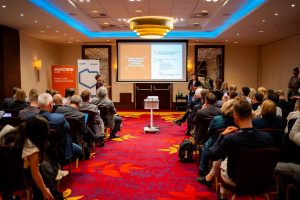
Following the plenary session, participants took part in three parallel workshops tailored to different target groups. This highly interactive part of the programme focused on dialogue, the exchange of experiences, and collaborative problem-solving, emphasizing the importance of cooperation between academia, business, and support institutions.
Track I, dedicated to SMEs and DeepTech startups, focused on support provided by the European Innovation Council and programme requirements. Participants were introduced to a new HPN DeepTech programme with the EIC Launchpad track. The NCP at NCBR offers substantive guidance in understanding EIC expectations and preparing applications, while AKCES NCBR supports business development and financing.
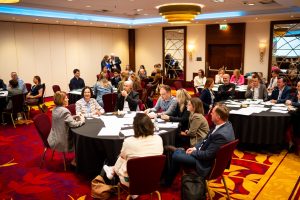
Track II, aimed at companies outside the DeepTech sector, explored opportunities under Pillar II of Horizon Europe. Participants learned about the rules of project participation, interpreting calls, building consortia, and defining their roles in international projects. A pitching module and networking session complemented the workshops, enhancing participants’ ability to present their potential and build partnerships.
Track III was aimed at the research commercialisation community and focused on various pathways for bringing innovative DeepTech ideas developed in academia to market.

Participants in the panel and workshops explored methods for analysing the potential of technologies, including their future implementation. They identified challenges related to the commercialisation of innovation and exchanged experiences in academia–industry collaboration. Examples of projects funded under the EIC Pathfinder and EIC Transition calls were presented, providing an excellent basis for reflection on whether and when researchers should become entrepreneurs. The session concluded with a presentation of current and upcoming EIC and EIE calls, with particular emphasis on those dedicated to the academic sector.
We thank all participants for their strong attendance, engagement, and valuable feedback.
We wish you every success in applying for grants under the Horizon Europe programme and invite you to join our future events.
