







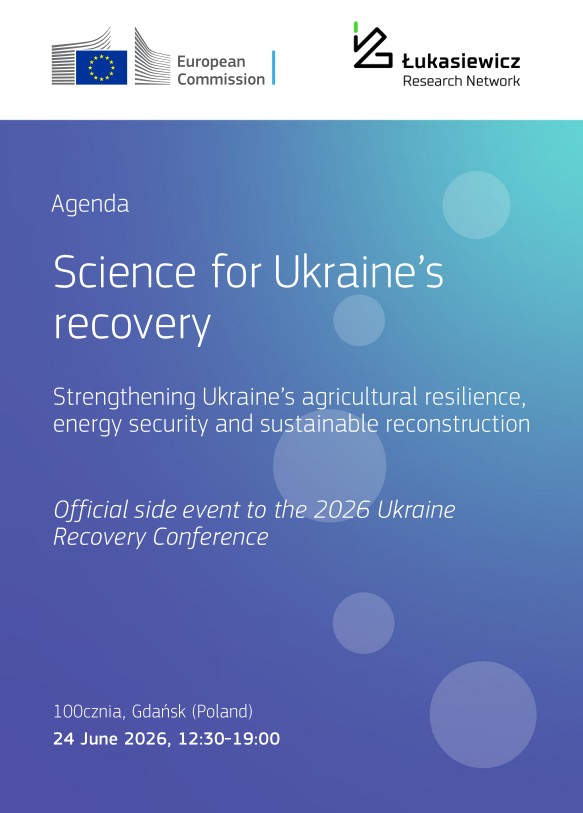
The JRC, in cooperation with Łukasiewicz Research Network, is organising its official side event in the framework of the Ukraine Recovery Conference (UCR).
This in-person event will showcase how integrated, evidence-based approaches and technical cooperation can contribute to addressing Ukraine’s key recovery challenges. It will present an integrated perspective on recovery, structured around four thematic panel discussions focusing on Smart Specialisation, resilience in agriculture, energy security and sustainable reconstruction of the built infrastructure, including the New European Bauhaus. This will allow the identification of synergies across these strategic sectors, supporting a coherent recovery approach aligned with Ukraine’s EU accession priorities.
The event will be followed by a networking reception.
Interested in joining in person? Please register via the link below and consult the draft agenda.
Practical information
- When
- Wednesday 24 June 2026, 12:30 – 19:00 (CEST)
- Where
- Grid Arthub at 100czniaNiterów 3, 80-864 Gdańsk, Poland
- Languages
- English, Polish, Ukrainian
Description
The Ukraine Recovery Conference (UCR), held annually, brings together governments, international organisations, financial institutions, businesses and civil society in a series of high-level events aimed at mobilising international support and investment for Ukraine’s reconstruction and reform in response to Russia’s full-scale war of aggression.
In this context, the European Commission plays a key role in maintaining international focus on Ukraine’s recovery, and these conferences serve as a valuable platform to align political support and mobilise funding. The 2026 edition of the conference will take place in Gdańsk, Poland, on 25-26 June. As in previous editions, different organisations are planning side events on the margins of the conference.
The venue
The event will take place at the Grid Art Hub, located on the upper floor of the historic Hall 31B within the 100cznia complex, just a short walk away from the European Solidarity Centre.
Originally built in the late 19th century as a shipyard wood-drying plant, the Hall 31B has been completely reborn through an adaptive reuse project, beautifully bridging industrial heritage with a zero-waste circular economy.
Today, it stands as a living showcase of the New European Bauhaus (NEB) principles. The conference hall is directly surrounded by creative workshops and resident studios, meaning that you will likely see local artists and innovators working in the adjacent offices during the event.
