






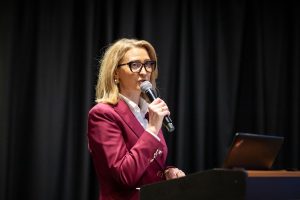
“Gender equality is a foundation of scientific excellence,” said Renata Rycerz, Deputy Director of the National Contact Point for EU Research Programmes (NCP) at the National Centre for Research and Development (NCBR), opening the conference “Horizon Europe. Successes of Women in Science and Innovation”, held on 30 March 2026 in Warsaw. The event brought together more than 150 participants from across Poland.
Renata Rycerz emphasised that gender equality is a strategic priority in Horizon Europe, and that EU Framework Programmes have consistently supported women in science and innovation for many years. “We are observing a steady increase in women’s participation in the programme, particularly in expert and decision-making roles,” she added. Professor Maria Mrówczyńska, Undersecretary of State at the Ministry of Science and Higher Education, highlighted that women are creative, innovative and willing to take on challenges. Gender-balanced teams generate better ideas, solve problems more effectively and respond more successfully to challenges. The Minister noted that women are well positioned not only to act as experts, but also to lead major research projects.
New NCBR calls dedicated to women
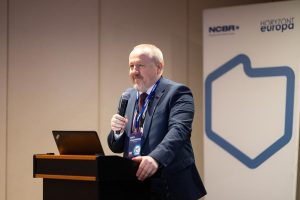
Professor Jerzy Małachowski, Director of the National Centre for Research and Development, drew attention to the persistent gap in women’s representation in STEM fields and emphasised that NCBR will continue to actively work towards reducing this disparity. He highlighted that the Centre has instruments specifically addressed to women. A new EEA-funded programme supported by Norwegian funds will soon be launched, including a dedicated call for projects in STEM fields led by women.
Director Małachowski also underlined that women are particularly strong in three key areas of NCBR activity: energy transition and environmental protection, public health, and digitalisation. At the same time, he pointed to the need for increased participation of women in the fourth pillar – security and defence – where dedicated calls are also expected to be announced soon.
At the end of the official opening, Professor Bogumiła Kaniewska, Chair of the Conference of Rectors of Academic Schools in Poland (CRASP), which granted honorary patronage to the event, addressed participants with a message delivered online.
Equality as a condition of research quality
The substantive part of the conference, “Equality and Research Quality in Horizon Europe”, was opened by Professor Marta Bucholc from the University of Warsaw. She shared her extensive experience in implementing ERC grants and other Horizon Europe projects, highlighting both the challenges and opportunities related to participation in European research competitions.
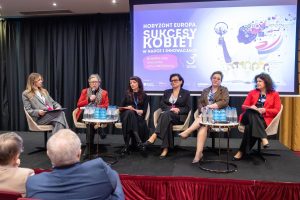
The panel discussion, moderated by Dr Natalia Schmidt-Polończyk from AGH University of Krakow, brought together distinguished researchers from leading Polish universities. The panelists reflected on the role of women in shaping the European research ecosystem. They pointed to persisting barriers requiring systemic solutions and presented good practices implemented at Polish universities. The discussion highlighted the growing number of initiatives supporting women leaders engaged in advancing gender equality, as well as examples of projects contributing to meaningful institutional change.
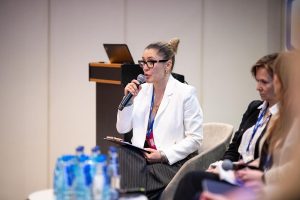
The discussion on the role of Equality Ambassadors in institutional transformation was introduced by Dr Anna Knapińska from the National Information Processing Institute. She discussed how Gender Equality Plans influence the functioning of Polish research institutions, identifying both areas where progress has been achieved and those requiring further action and consistency in implementing equality policies.
The panel on gender equality in the transformation of the research and innovation system was moderated by Dr Monika Ryndzionek, expert at NCP/NCBR. She invited Equality Ambassadors – researchers and leaders engaged in organisational culture change. In their contributions, they emphasised that gender equality is not merely a formal project requirement, but a fundamental condition for conducting responsible, innovative and socially relevant research. They referred to concrete examples demonstrating that diverse teams are better at identifying research problems, formulating relevant questions and developing more adequate solutions. As they stressed, equality is not an add-on, but a qualitative dimension embedded in the very nature of scientific research.
Women facing challenges and innovation in EU Framework Programmes
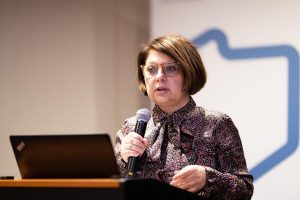
Bożena Lublińska-Kasprzak, Deputy Director of NCBR, emphasised that gender equality is not only a social or ethical issue, but also a condition for innovation. “Gender equality is not just a value – it is a concrete instrument for improving quality. At the macro level, we can observe that more innovative countries are also more equal,” she added.
She noted that women should not be perceived as a niche, as they represent one of the most significant growth markets. The development of women’s entrepreneurship is becoming an important economic strategy in many countries worldwide. Companies are increasingly adapting their products and services to better respond to women’s needs and preferences. Despite positive developments, however, women remain underrepresented in many sectors of the economy.

The final panel focused on women coordinators of projects funded under the European Commission’s Framework Programmes and was moderated by Aleksandra Ihnatowicz, the expert in NCP/NCBR. Panelists shared their experiences as managers of EU-funded projects, emphasising that diversity is crucial for the effective functioning of project teams, particularly in international environments.
Following the plenary session, Forum participants were able to take part in one of several activities: the workshop “Promoting women in science. How to communicate your achievements effectively?” led by NCP/NCBR expert – Beata Oleksy, speed networking sessions, or mentoring meetings led by NCP experts Dr Weronika Gawęda and Mirosław Raba.
The Forum “Horizon Europe. Successes of Women in Science and Innovation” marked a summary of the activities of the National Contact Point for EU Research Programmes at NCBR promoting the Equality Ambassadors initiative, carried out since March 2025 as part of the campaign Equality for Innovation.
We would like to thank all participants for their active engagement in the event. We hope that the Forum will become a recurring initiative, as we observe a growing need to connect expert knowledge with the experience of practitioners implementing projects, so that gender equality becomes a genuine component of scientific excellence rather than merely a declaration.
