





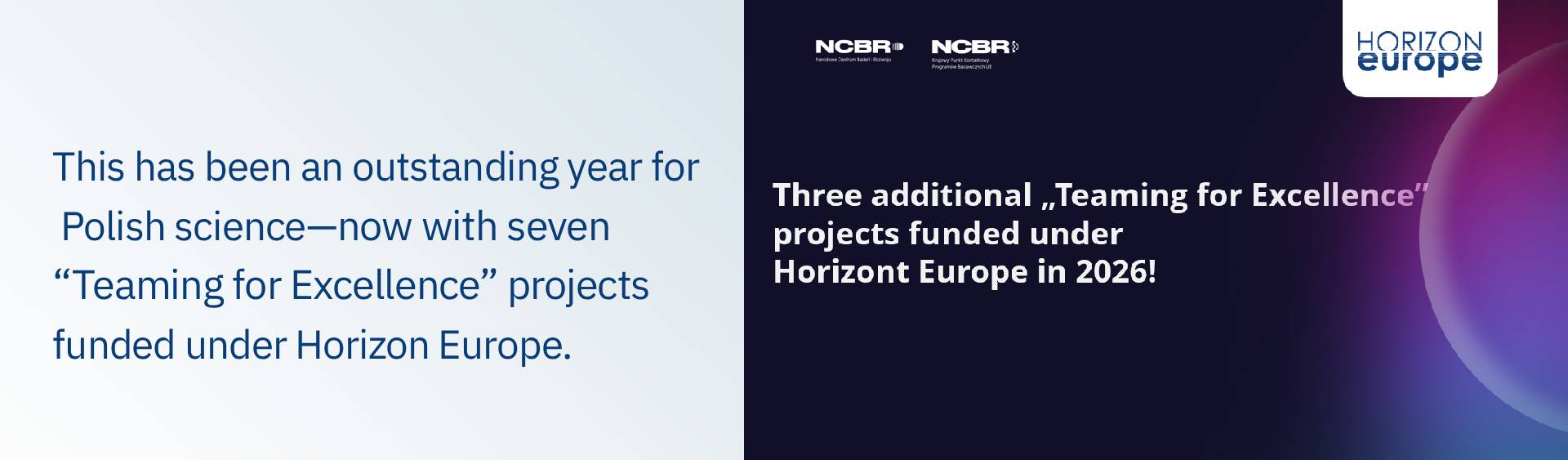
This year has been exceptional for Polish science – three additional successful projects have joined the group of previously funded “Teaming for Excellence” projects (Widening area, WIDERA Work Programme, Horizon Europe and Horizon 2020). Following the latest call, Poland now has a total of 10 “Teaming for Excellence” projects, including 7 funded under Horizon Europe, and ranks second—alongside Greece—just behind Portugal.
Grants under the “Teaming for Excellence” call support the creation and development of Centres of Excellence, designed to act as “lighthouses” that drive new investments and foster reforms in research and innovation systems across Widening countries. These countries, which face relatively lower levels of participation and performance in research and innovation, benefit from targeted support aimed at strengthening their R&D excellence.
- Project “Centre of Excellence in Railway Engineering” (CERES), coordinated by Poznań University of Technology;
- Project “QuRAK Center of Excellence – Quantum Research and Applied Knowledge” (QuRAK), coordinated by the Institute of Physics, Polish Academy of Sciences;
- “RAPid TranslatiOnal Research – Heart Failure” (RAPTOR-HF), coordinated by Wroclaw Medical University.
Additionally, another Polish project – “CENtre for TErahertz Research and Applications 3” (CENTERA3), coordinated by Warsaw University of Technology – has been placed on the reserve list. Two other Polish projects that advanced to the second stage of the call were not funded. However, CENTERA3 and the two other projects received the Seal of Excellence, a prestigious quality label awarded by the European Commission to proposals that achieved very high evaluation scores but could not be funded due to limited budget.
High prestige and significant financial support
What are “Teaming for Excellence” projects? These are among the most prestigious and highest-budget projects within the Widening component, as well as among the largest in Horizon Europe overall. Each of the three newly funded projects will run for six years and receive €15 million from Horizon Europe. This funding will be matched by the Polish Ministry of Science and Higher Education, and in the case of the QuRAK project, also by the Foundation for Polish Science under the MAB FENG programme.
The Teaming instrument fosters the creation of new and the enhancement of existing Centres of Excellence by connecting research institutions from Widening countries with leading organisations across Europe. It serves as a powerful mechanism for integrating these countries into world-class research. Outstanding teams, including those from Poland, gain access to financial, organisational and institutional support, enabling them to carry out cutting-edge research in collaboration with top international partners on a significantly larger scale.
At the same time, these projects strengthen the development and autonomy of Centres of Excellence, support effective technology transfer, and drive the modernisation of research management and administrative processes.
Poland’s growing Teaming portfolio
Poland currently has 10 ongoing “Teaming for Excellence” projects. The first three—Sano (Sano Centre for Computational Personalised Medicine, International Research Foundation; the proposal was submitted by AGH University of Science and Technology), ENSEMBLE3 (ENSEMBLE3 Ltd., originating from the Łukasiewicz Research Network, the Institute of Electronic Materials Technology and the University of Warsaw, with support from the National Centre for Research and Development), and NOMATEN (National Centre for Nuclear Research)—were funded in 2019 under Horizon 2020.
Four additional projects—RACE (International Institute of Molecular and Cell Biology), TRIO-VI CoE (International Centre for Translational Eye Research – ICTER, Institute of Physical Chemistry of the Polish Academy of Sciences), Astrocent Plus (Nicolaus Copernicus Astronomical Center of the Polish Academy of Sciences), and P4Health (Łukasiewicz Research Network – PORT Polish Center for Technology Development)—were funded in earlier Horizon Europe calls.
To strengthen cooperation and joint efforts in advancing science in Poland, all these projects formed the informal Teaming Club Poland / Polish Teaming Club (PTC) at the end of 2025. The three newly funded flagship projects will now join this distinguished group.
A success built on excellence and NCP support
The success of Polish research institutions in the Teaming for Excellence call is the result of ambitious research planning, structural reforms, and the intensive work of Polish research teams. It has also been supported by a dedicated support system organized by the National Contact Point for Horizon Europe (NCP) at the National Centre for Research and Development (NCBR), including proposal preparation and expert pre-screening (organized and funded under the European project NCP_WIDERA.NET). All of these factors have contributed to the outstanding quality of the submitted and awarded proposals.
