



Renata Rycerz, Acting Deputy Director of the National Contact Point for Horizon Europe at the NCBR (NCP Department) emphasized during a study visit in Brussels, dedicated to energy-efficient and sustainable construction, as well as the New European Bauhaus initiative, that success in the Horizon Europe programme requires more than good ideas alone. It demands strong partnerships, openness to collaboration, and a willingness to engage across sectors and across Europe. The visit took place on 11-12 march 2026.
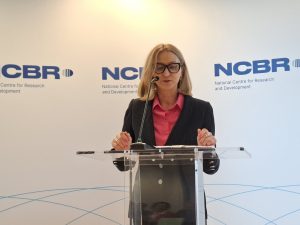
Opening the meeting, Maciej Zdanowicz, Policy Advisor at the NCBR Office in Brussels, highlighted the importance of international cooperation and the role of the Office in strengthening it. The participants were also welcomed by Katarzyna Nowak from the Warsaw Institute of Technology, operating within the Łukasiewicz Research Network.
The two-day study visit, co‑organised by the NCP Department, the NCBR Office in Brussels, and the Industry Contact Point Low-Emission Technologies and Clean Energy, brought together 55 participants from nearly 20 EU Member States. The programme included expert presentations, pitching sessions, a brokerage meeting, and a visit to Thor Park in Genk.
Strengthening Poland’s Position in the European Research and Innovation Ecosystem
The priorities of the European Union and their impact on the future of urban built developement were discussed during the panel “Energy‑Efficient Construction and the New European Bauhaus,” moderated by Mirosław Raba, the Global Challenges Unit Manager, NCP Department.
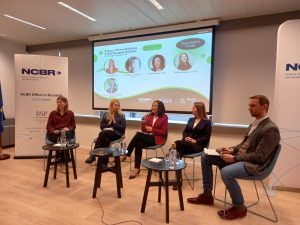
The discussion focused extensively on the challenges associated with the low uptake of innovation and the slow pace of renovating existing buildings. Participants also explored key research and innovation trends in the construction sector, highlighting the importance of active community involvement in shaping urban spaces—both at the level of individual buildings and entire neighbourhoods.
When asked to assess Poland’s position in building an effective research and innovation ecosystem, Anastasyia Yuchyshyna from the European Construction and Sustainable Built Environment Technology Platform noted that the large number of older buildings in the country—often perceived as a burden—can in fact be turned into an advantage. These buildings provide ideal conditions for testing innovative renovation technologies and models, thereby accelerating the modernisation of the entire sector.
Prof. Barbara Widera also took the floor, emphasising the crucial role of residents in shaping cities and neighbourhoods. “We are building spaces for people. Construction should create functional, environmentally friendly places to live, work, and grow,” she said. She added that a change is possible only when it is developed in collaboration with end users and supported by their acceptance. Even the best‑designed space will not endure if people do not feel comfortable in it.
International Networking and Brokerage Meeting
The second part of the event featured a total of 21 collaboration offers, with participants presenting their project ideas under Horizon Europe (pitch presentations). During the brokerage session, more than 50 one‑to‑one meetings took place, enabling new connections, a better understanding of potential partners, and the initiation of cooperation discussions.
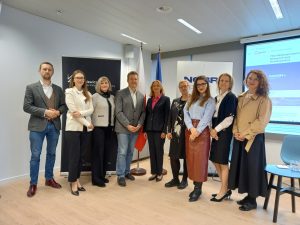
On the second day, the group visited Thor Park in Genk—an exceptional area that combines the region’s industrial heritage with state-of-the-art research and development infrastructure. Participants met with companies and institutions working in the fields of energy, manufacturing, and smart cities. They also visited the Thor Living Labs, where innovative solutions are tested in real-life conditions. They spoke with representatives of EnergyVille VITO, Wally Automation, Orion Grid Technologies, SwiftPharma, and POM Limburg.
Thank you to all participants and co‑organisers from the Warsaw Institute of Technology and the NCBR Office in Brussels for their active participation, engagement, and fruitful cooperation.
